
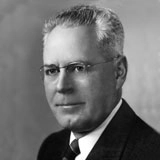
Tim Downs 2023-present

Minnesota State University Moorhead celebrates the achievements of the Fall 2026 graduating class.
Dragons are committed to sustainability. The program you received at the commencement ceremony was designed and printed to reduce environmental impact. Commemorative copies of the full program can be ordered on demand for $10 by emailing printing@mnstate.edu.
Minnesota State University Moorhead is a caring community promising all students the opportunity to discover their passions, the rigor to develop intellectually and the versatility to shape a changing world.
In the simplest and most idealistic terms, our purpose at Minnesota State University Moorhead (MSUM) is to transform the world by transforming lives. Nowhere is this purpose more evident than at Commencement, as our newest graduates prepare to make their marks on the world. They join thousands of MSUM alumni who have experienced the transformative power of higher education and used their education to make our world a better place.
We show relentless drive and resourcefulness, pushing forward with purpose and tenacity.
We explore ideas to expand our learning, power our growth and encourage us to think deeper.
We believe in everyone’s potential by investing in people and championing their growth.
Date: December 16, 2026
Time: 6:00 p.m.
Location: Hansen Theatre, Roland Dille Center for the Arts
Date: December 17, 2026
Times: 10:00 a.m. & 2:00 p.m.
Location: Hansen Theatre, Roland Dille Center for the arts
Majors and Minors
The Commencement Program lists all majors and minors which have been completed. If a student has completed two majors, the majors are separated by a comma (English, History); if a student has completed a major and a minor, the major and minor are separated by a semi-colon (English; History). If a student has earned a minor via the Tri-College University, the home institution is listed after the minor and placed in parentheses, i.e. French (Concordia).
Graduate Candidates
Candidates receiving graduate degrees are listed in the program. The listing also contains the title of their thesis or project and their faculty advisor. Each candidate that participates in the ceremony is wearing the appropriate master’s or specialist hood. The color of the velvet edging on the hood represents the academic discipline and the silk lining (red and white) represents Minnesota State University Moorhead.
University and academic program honors and distinctions are listed on this page. Graduates may receive various colored cords or sashes not listed here. These cords or sashes may indicate participation in or affinity to a particular nonacademic campus group or organization.
Students who complete at least 30 credits at Minnesota State University Moorhead as candidates for baccalaureate degrees may graduate with the following honors:
Such honors are computed from the cumulative grade point average earned in all courses at MSU Moorhead. The graduates who have earned these honors will have the achievement listed on their academic transcripts. The CUM LAUDE graduates wear white honor cords. The MAGNA CUM LAUDE graduates wear red honor cords. The SUMMA CUM LAUDE graduates wear red and white honor cords.
The MSU Moorhead Honors Program exists to award and encourage superior academic performance. Students who have earned a 3.50 grade point average during their freshman year are invited to participate in the Honors Program. Those who complete the rigorous Honors Program curricular requirements are listed in the Commencement Program and have the achievement listed on their academic transcripts.
Alpha Kappa Delta, the National Sociology Honor Society, seeks to acknowledge and promote excellence in the study of sociology, the research of social problems, and other social and intellectual activities to help improve the human condition. Membership is open to undergraduates who are sociology majors, at least juniors, rank in the top 35% of their class or have at least a 3.5 overall GPA, have at least a 3.0 GPA in sociology courses prior to initiation, and have completed at least four sociology courses.
Alpha Phi Sigma, the National Criminal Justice Honor Society, recognizes academic excellence of undergraduate criminal justice majors who maintain a GPA of 3.5 or above, are nominated by faculty, and are in the top 35% of their class. The goals of Alpha Phi Sigma are to honor and promote academic excellence, community service, educational leadership, and unity.
Alpha Upsilon Alpha, the honor society of the International Reading Association, was created in 1985 to recognize and encourage scholarship, the development of personal and professional leadership, and service to the field of reading at both the undergraduate and graduate levels.
The Greek letters chosen for this honor society are significant: They come from the words Anagnosis (reading), Upotrophia (scholarship) and Archon (leadership). The society motto, which is attributed to Horace, says it all: “Lege sapere aude,” or “Read, dare to be wise.”
Membership in Alpha Upsilon Alpha brings a sense of scholarly accomplishment in the field of reading and language arts. Members are acknowledged for having excelled in their chosen field of study, and are recognized as professionals committed to the importance of reading and language arts in education. Beta
Beta Beta (βββ) National Biology Society is an academic society for students who major in Biology. The requirements for membership in the Omega Mu chapter of Beta Beta Beta are (I) at least three biology courses in the biology major, and (2) a minimum GPA of 3.0 in those courses. The honor pin displays three Greek letters, Beta Beta Beta, and a coiled serpent. The first Beta stands for the Greek word BALANNOS, which means acorn; it represents life in and on the ground. The second Beta stands for the Greek word BOUDETASE, which means little bird; it represents life in the air. The third Beta stands for the Greek word BOAX, which means fish; it represents life in the water. All three words may be summed up in one word BIOS, meaning life. The coiled serpent in the center of the pin is an ancient symbol of wisdom. Graduating students who are members of Beta Beta Beta may wear the red and green cords symbolic of the Society.
Beta Gamma Sigma (ΒΓΣ) honor society was founded in 1913 as an academic society for students who major in Business or Accounting. Students ranking in the top 10 percent of the baccalaureate program at schools accredited by AACSB International – The Association to Advance Collegiate Schools of Business – are eligible for this invitation. AACSB Accreditation is known, worldwide, as the longest standing, most recognized form of accreditation a business program can earn. The blue and gold honor cord worn by Beta Gamma Sigma members features a gold (metal) key charm attached to the knot above the tassel on one end of the blue cord.
Chi Sigma Alpha is a member of Chi Sigma Iota, which is an international honor society that values academic and professional excellence in counseling. We promote a strong professional identity through members (professional counselors, counselor educators, and students) who contribute to the realization of a healthy society by fostering wellness and human dignity. The membership requirements include, “Those who have a cumulative GPA of 3.5 or better on a scale of 4.0 and are deemed promising for endorsement as a professional counselor whose ethical judgment and behavior will be exemplary” (CSI Bylaws, Article 4.1). Members of Chi Sigma Alpha wear blue and white honor cords and/or a white stole that displays the Chi Sigma Iota emblem and Greek Letters.
Financial Management Association (FMA) honor society was founded in 1974 and remains the only national honor society specifically for finance students. The group is dedicated to the ongoing development of financial theory and sound, ethical financial practices. To qualify for membership, students must maintain a GPA above 3.5 in their finance coursework and earn a major, minor, or certificate in finance at MSUM. Honor society inductees wear a silver sash with the logo of FMA printed in blue.
Golden Key International Honour Society is the world’s largest collegiate honor society founded in 1977, comprised of more than 2 million undergraduate, graduate and alumni members. Membership into the Society is by invitation only and applies to the top 15% of college and university sophomores, juniors and seniors, as well as top-performing graduate students in all fields of study, based solely on their academic achievements. With over 400 student chapters worldwide, Golden Key recognizes highly motivated academic achievers who will become leaders and contributors to society in the future. Golden Key offers many additional memberonly privileges that highlight the three pillars of Academics, Leadership and Service.
Lambda Epsilon Chi “LEX” is a national honor society recognizing academic excellence for Paralegal students. Invitations for membership are extended to those students who are declared majors in MSUM’s Paralegal Department and who have met the following criteria: (1) completion of at least two-thirds of the course requirements for the major, and (2) cumulative GPA of 3.5 in Paralegal courses.
Lambda Pi Eta is the official honor society for communication studies students. It is sponsored by the National Communication Association (NCA). Students must have a 3.0 cumulative GPA and a 3.25 GPA for communication studies courses. The pin features the Greek words lambda, pi, and eta which stand for Aristotle’s three forms of proof: logos, pathos, and ethos.
Phi Alpha is a national social work honor society which was established in 1960. The purpose of Phi Alpha is to promote humanitarian goals and ideals and to provide a closer bond among students of social work. The membership requirements include excellence in scholarship, with a minimum GPA of 3.25 and achievement in social work.
Pi Kappa Lambda, the national honor society in music, was established in 1918 at Northwestern University in Illinois to provide an organization dedicated to the furtherance of music in education and education in music in colleges, universities, and other institutions of higher learning which offer music degree programs. Election to the Epsilon lota chapter (established at MSUM in 1982) requires that students be outstanding in scholarship and musicianship, and that candidates in their junior year be in the top 10% of their class, that seniors be in the top 20%, and that graduate students have satisfactorily completed the requirements of their degrees. The insignia pin of Pi Kappa Lambda is a gold Grecian lyre with symbols of music and drama (panpipes and mask with foils) on each side of the three strings of the lyre.
Pi Sigma Alpha is a national honor society for political science majors. The requirements for membership in the Alpha Eta Mu chapter of Pi Sigma Alpha are (1) completion of ten semester credits in political science including one 300-level class, (2) a minimum of 3.0 GPA in political science courses, and (3) a cumulative GPA of 3.0. The honor pin is a small gold pin with the honor society’s Greek letters on the front and the honor cords are red and white.
Psi Chi is an honorary society founded in 1929 for psychology majors. Psi Chi is a member of the Association of College Honor Societies and an affiliate of the American Psychological Association and the Association for Psychological Science. The MSUM Chapter of Psi Chi was established in the Psychology Department in 1984. In addition to the national membership requirements of a 3.0 GPA, class rank in the top 35%, completion of three semesters of college, and nine semester hours of psychology courses, the MSUM chapter requires a minimum GPA of 3.25 in psychology courses. Members of Psi Chi wear a medallion that displays the Psi Chi emblem of the Greek letters Psi and Chi.
Sigma Delta Pi, the National Collegiate Hispanic Honor Society (La Sociedad Nacional Honoraria Hispánica), is devoted exclusively to students of Spanish in four-year colleges and universities. It was established on November 14, 1919, at the University of California in Berkeley. Upsilon Sigma, the local chapter of SDP was organized at MSUM in the fall of 2000. Requirements for membership are (1) completing at least three years or the equivalent of college Spanish, including at least three semester hours of a third-year course in Hispanic literature or Hispanic culture and civilization, (2) a minimum GPA of 3.0 in Spanish, and (3) student rank in the upper 35% of their class. The Greek expression, Spanias Didagei Proagomen, stand for the motto, “Let us follow after Spain’s inspiration.” The honor pin and cord hearken back to the colors on the Spanish national flag and the coat of arms of Castilla y León, both which depict lions and castles in the checkered corners of the crest.
Sigma Lambda Chi is an international and academic honor society for students majoring in construction management. It is known for being a society of leaders in construction. Chapters are located throughout the United States and Australia. It was founded as an honorary society on April 30, 1949 at Michigan State University in East Lansing Michigan. In 1991, Sigma Lambda Chi became a member of the Association of College Honor Societies, Inc. Requirements for membership are (1) complete two academic years of study toward a degree in Construction, (2) obtain an overall scholastic average in the upper 20% of his or her incoming class, (3) study at the present institution for the preceding six months, (4) demonstrate leadership, character, and personality traits which will give promise of reflecting credit upon Sigma Lambda Chi, (5) participate in one or more extracurricular activities, and (6) work in some phase of the construction industry.
Sigma Phi Omega, the National Gerontology Honor Society, recognizes academic excellence of those who study gerontology and aging. Local chapters serve as links within their respective communities to promote interaction between gerontology educators, students, alumni, and local professionals. Membership is open to undergraduates who are gerontology majors and who are in at least their second term of enrollment with a cumulative GPA of at least 3.5.
Sigma Pi Sigma (ΣΠΣ) is the physics honor society and was founded in 1921. Election to ΣΠΣ is earned by a minimum GPA of 3.0 and demonstrated excellence in at least two of four categories; research work, outreach participation, Society of Physics Students involvement or outstanding academic achievement in physics. ΣΠΣ exists to honor and encourage physics scholarship, to be of service to the various communities it may influence, and to be a fellowship of persons who have shared in the traditions and culture of physics. The name ΣΠΣ comes from the first letters that compose the society motto Σκεψιζ Προστατηζ Συνεσεωζ which translated from Greek is “investigation, the forerunner of knowledge”. The official insignia and key consists of a voltmeter, lamp and dynamo. The voltmeter symbolizes the high accuracy which is the hallmark of careful experiments, the lamp is the symbol of knowledge (Σοφια in Greek) and the dynamo represents the creative energy that is so necessary to productive research. The MSUM Sigma Pi Sigma chapter was founded in 1974.
Sigma Theta Tau International is an honorary society for nursing majors, and was founded in 1922. The mission of the Honor Society of Nursing, Sigma Theta Tau International, is advancing world health and celebrating nursing excellence in scholarship, leadership, and service. Founded in 1922, the name Sigma Theta Tau comes from the Greek words storgé, thárros, and timé, meaning “love,” “courage,” and “honor.” STTI became incorporated in 1985 as Sigma Theta Tau International Inc. STTI membership is by invitation to baccalaureate and graduate nursing students who demonstrate excellence in scholarship and to nurse leaders exhibiting exceptional achievements in nursing. With more than 135,000 active members in more than 85 countries, Xi Kappa Chapter at Large includes MSU Moorhead, North Dakota State University, Jamestown University and Concordia College.
The caps and gowns worn at formal academic events in American colleges are the direct descendants of the everyday costumes worn in the universities of Medieval England when each school had its peculiar dress so that an Oxford student could be distinguished from a Cambridge student. Because of the tremendous growth of American colleges, and the confusion that would result if each were to adopt a distinctive costume, the Intercollegiate Bureau of Academic Costume was organized. The Bureau has established a uniform code that over 700 institutions have adopted.
There are three types of gowns and three types of hoods for bachelors, masters, and doctors. The bachelors gown has a long pointed sleeve, whereas the masters gown has a long closed sleeve, square at the end. The doctors gown is characterized by a voluminous bell-shaped sleeve with three velvet bars.
The hoods for all degrees are lined with silk in the official academic color or colors of the institution conferring the degree and have an edging or trim of velvet, the color of which indicates the academic discipline or faculty to which the degree pertains. The bachelors hood is not worn by candidates for the baccalaureate degree but only by those upon whom this degree has been previously conferred. The masters hood is considerably longer, has a wider velvet edging, and exposes more of the lining. The doctors hood has wide panels at the side. It has the widest velvet edging, greatest length, and fullest exposure of the lining.
The black mortarboard cap with tassel is worn with each type of gown. Those holding a doctor’s degree are privileged to wear a gold tassel. Masters and bachelors wear tassels that are either black or of the color appropriate to the academic discipline in which they are graduating.
Some of the colors which may be observed at this commencement and which symbolize various faculties are as follows:










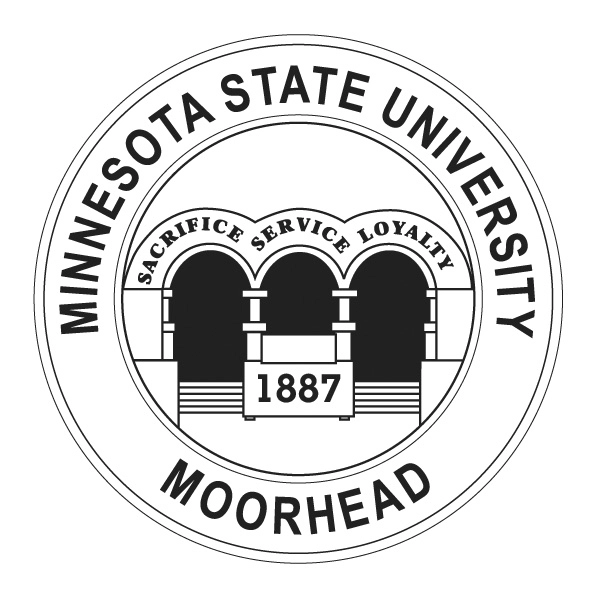
University Seal
Minnesota State University Moorhead’s Seal represents its history, mission, and distinctive characteristics. It is reserved for official and ceremonial use. In the University’s early history, Old Main was the largest and most impressive building in the area. A fire in 1930 destroyed most of the school’s main building, except the arches of Old Main. Those arches became a significant symbol of the school’s ability to survive and were incorporated into the University Seal.
University Mace
The University President or his designee carries this staff in ceremonial processions to symbolize the University’s authority. Lyle Laske, Professor of Art Emeritus, crafted the staff for the University. The staff is sculpted from Brazilian rosewood, rubbed and polished to a deep luster. Its tips are cast in bronze and gold plated. The top piece on the staff, also in rosewood, is shaped in a universal form that symbolizes the medieval northern world. The staff rests in a base that is a solid, circular piece of rosewood. The staff was presented to President Roland Dille in 1978.

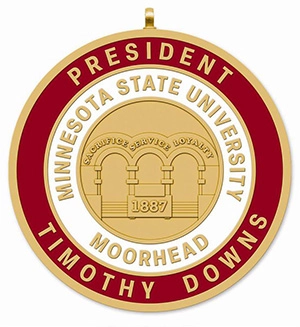
Presidential Medallion
The Presidential Medallion serves as a sign of the educational mission of Minnesota State University Moorhead. The President’s commitment to the University’s purposes is renewed in each solemn academic function, when it is appropriate to wear the medallion and be recharged by its symbols.
College Marshals
The College Marshals are senior faculty representing their colleges.
Minnesota State University Moorhead is extremely proud to recognize the following State and U.S. Professors of the Year
Kyja Kristjansson-Nelson (2014)
Brian Wisenden (2013)
Martin Grindeland (2008)
Ellen Brisch (2007)
Mark Wallert (2005)
Jim Bartruff (2001)
Andrew Conteh (1999)
David Mason (1994)
Evelyn Lynch (1992)
Delmar Hansen (1987)
Administered by CASE (The Council for Advancement and Support of Education) and sponsored by The Carnegie Foundation for the Advancement of Teaching, the Minnesota State Professor of the Year award recognizes professors for their influence on teaching and their commitment to undergraduate students.
Russell Colson (2010)
The U.S. Professor of the Year awards program, created in 1981, celebrates outstanding instructors across the country. Also, sponsored by CASE and the Carnegie Foundation for Advancement of Teaching, it is the only national initiative specifically designed to recognize excellence in undergraduate teaching and mentoring. Only four national winners are recognized each year.
Criteria
Extraordinary dedication to undergraduate teaching, which is demonstrated by excellence in the following areas: impact on and involvement with undergraduate students; scholarly approach to teaching and learning; contribution to undergraduate education in the institution, community and profession; and support from colleagues and current and former undergraduate students.
Congratulations to the Fall 2026 graduates of Minnesota State University Moorhead.