
Dragon maps the Ionosphere
For Taytum Nelson, a standout undergraduate studying physics, math, and computer science, curiosity has always driven her to learn more about the world she lives in. In her sophomore year of high school, she attended a camp to learn about Artificial Intelligence and got hands-on experience programming a facial emotion recognition system with a small group of students.
"It was that same year that I became really interested in how the world works, and was interested in physics," Taytum says.
That proactive approach to research has already garnered national attention. This spring, Taytum was named a 2026 Goldwater Scholar, receiving one of the most prestigious undergraduate awards in the natural sciences, engineering, and mathematics. Congress established the scholarship in 1986 in honor of former U.S. senator Barry Goldwater to identify and support the next generation of great American researchers.
Although both of her parents are Minnesota State University Moorhead alumni, Taytum chose Moorhead because it was close to home, and the unique opportunity to get hands-on experience as an underclass student.
"I knew that if I went to MSUM, I could start doing research my first year on campus. I wouldn't get that in most other places," Taytum says.
She immediately got plugged into campus, joining the society of physics students club, where she learned about the National Science Foundation's Research Experiences for Undergraduates (REU). The REU's are highly competitive research internships in a variety of STEM fields.
Taytum applied, and was accepted, to spend her summer in Menlo Park, California at SRI. While there, she and another student conducted geospatial studies, specifically working on mapping the Ionosphere. 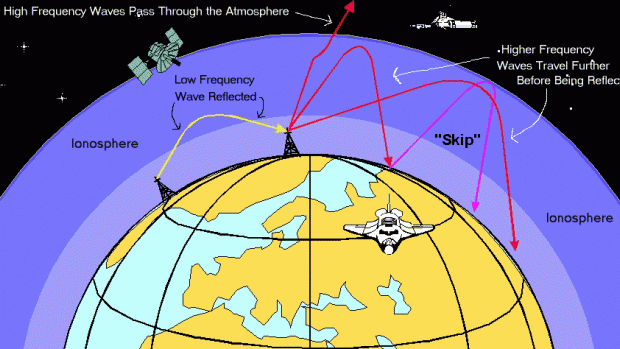
Ionosphere | NOAA/NWS Space Weather Prediction Center
The Ionosphere is the part of the Earth's atmosphere that is the farthest from the surface. It is within the Ionosphere that satellites orbit, including the International Space Station, and radio waves that are used for communication and GPS travel.
The Ionosphere is also home to solar storms and other space weather, which can damage satellites and block radio waves. Taytum's research was focused on mapping the density and movement of electrons in this region of the upper atmosphere, which could lead to predicting space weather.
Research in predicting space weather has been growing in importance in the last few years, considering an incident in 2022 where American aerospace company SpaceX lost almost all of their satellites upon launch due to a space weather phenomenon. SpaceX was in the midst of launching its Starlink satellites, which would provide internet services. More than three quarters, 38 out of their 49 satellites, malfunctioned and were ultimately lost due to a geomagnetic storm, as its impact was not accurately predicted.
Research like Taytum's paves the way to prevent accidents like this in the future.
For Taytum, this research opportunity helped her realize that she wanted to make a career out of it. "Full-time research is something I really enjoyed, and could see myself doing in the future," she says.
In the future, Taytum will continue being curious and looking for opportunities to learn, hoping to continue all the way to post-doctorate education. "I'm looking into a PhD program and then a post-doctorate. What I'm interested in now is theoretical or particle physics," she says.
But for now, Taytum will continue enjoying her time at Moorhead, learning as much as she can about the world around her, and connecting with her professors in meaningful ways. Earning the Goldwater Scholarship provides a powerful momentum as she continues to explore the complexities of the physical world.
"I really enjoy that MSUM is a smaller campus. I'm able to truly know my professors and find out about their personal research," she says.
References used
Pospekhov, Alex, and Alexey Shirobokov. "Space Weather Requires Our Attention Now More than Ever." SpaceNews, 25 Apr. 2024, spacenews.com/space-weather-requires-our-attention-now-more-than-ever/.
"Ionosphere." NOAA / NWS Space Weather Prediction Center, www.swpc.noaa.gov/phenomena/ionosphere. Accessed 25 Sept. 2024
Physics Degree
Physics and astronomy students learn how to create physical models and make predictions, apply scientific methods to solving theoretical and experimental problems, use new technologies to solve problems and clearly communicate technical principles.
Learn more about Physics & AstronomyMore Stories from Dragons
The Ripple Effect
Tobias and Rachel Boegel carry on lessons learned at MSUM to create healthy opportunities for their community.

Honors College launches with 300 students
Minnesota State Moorhead's inaugural Honors College class launches with 300 students. The curriculum focuses on meaningful work, interdisciplinary courses, and a mentorship program.
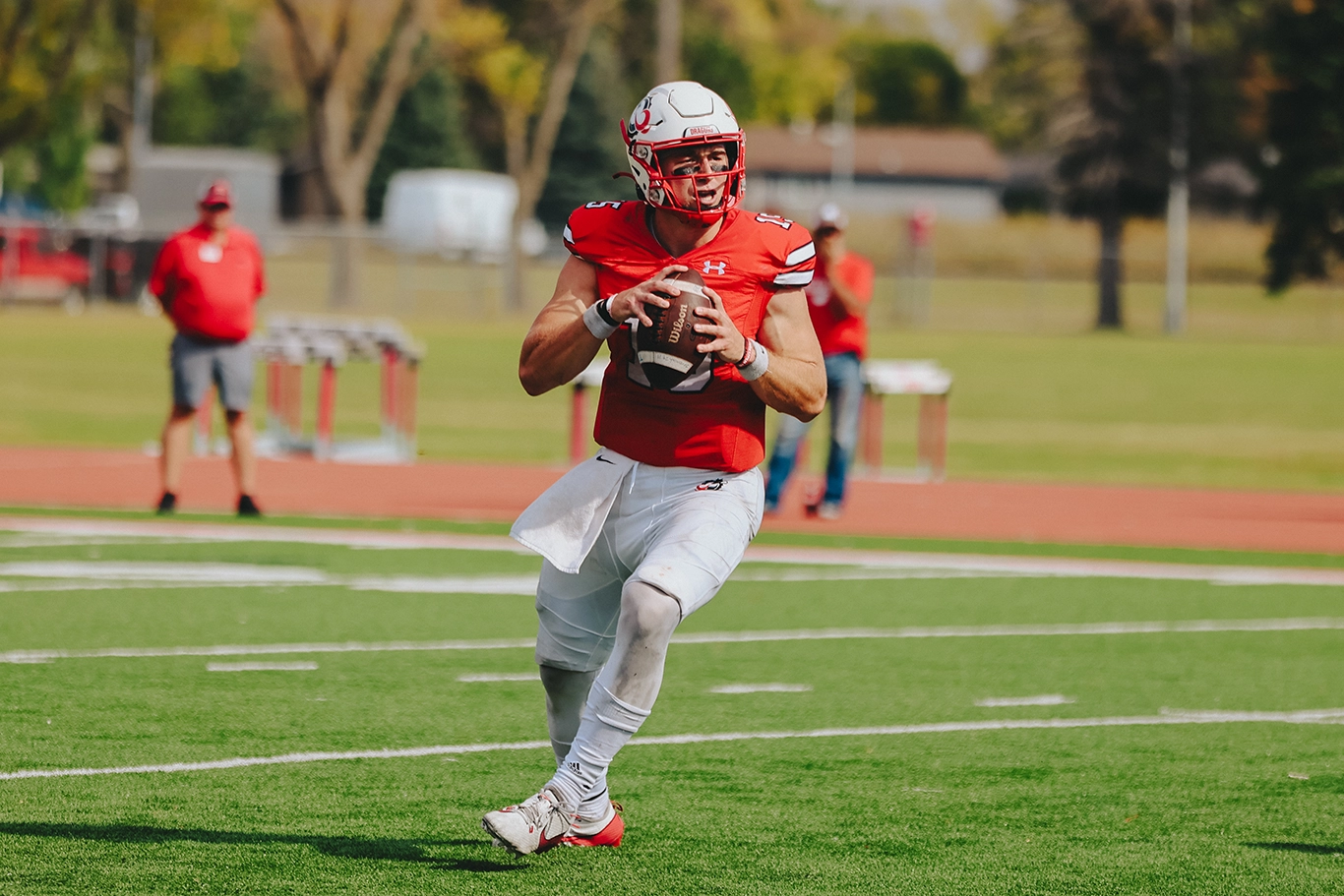
Quantum Quarterback: Physics prodigy Jack Strand is the NFL’s most intriguing rookie
MSUM football quarterback Jack Strand is pursuing two dreams: football and the final frontier.